When people think of “world records,” one name usually comes to mind first: Guinness World Records. It’s been part of pop culture for decades. But it isn’t the only organization that verifies and certifies world records — and depending on what you’re looking for, it may not be the right fit for your goals.
Official World Record (OWR) operates differently — structurally, legally, and in terms of how it approaches the process. Here’s an honest, factual look at how the two compare.
A Quick History of Both Organizations
Guinness World Records began as an idea for a book to settle pub arguments, conceived in the early 1950s by Sir Hugh Beaver, then Managing Director of the Guinness Brewery. Twin brothers Norris and Ross McWhirter co-founded the book in London in late August 1955. As of the 2026 edition, it’s now in its 71st year of publication, published in 100 countries and 40 languages, with over 53,000 records in its database.
In 1997, Guinness’s parent company merged with Grand Metropolitan PLC to form Diageo, and the Guinness World Records property was sold off in 2001. Since 2008, Guinness World Records has been owned by The Jim Pattison Group, a Canadian conglomerate that also owns Ripley Entertainment.
Official World Record was founded more recently, in the 21st century, in Barcelona, Spain. From the outset, it was established as a non-governmental organization — not a publishing company — with a mission centered on verification, social impact, and inclusive recognition rather than commercial publishing.
Ownership and Structure: NGO vs. Private Company
This is one of the clearest structural differences between the two organizations.
Guinness World Records is a for-profit, privately held company, currently part of the Jim Pattison Group’s portfolio of entertainment and media businesses. Its core business model has historically centered on book sales, licensing, television, and — more recently — consultative services for brands and organizations.
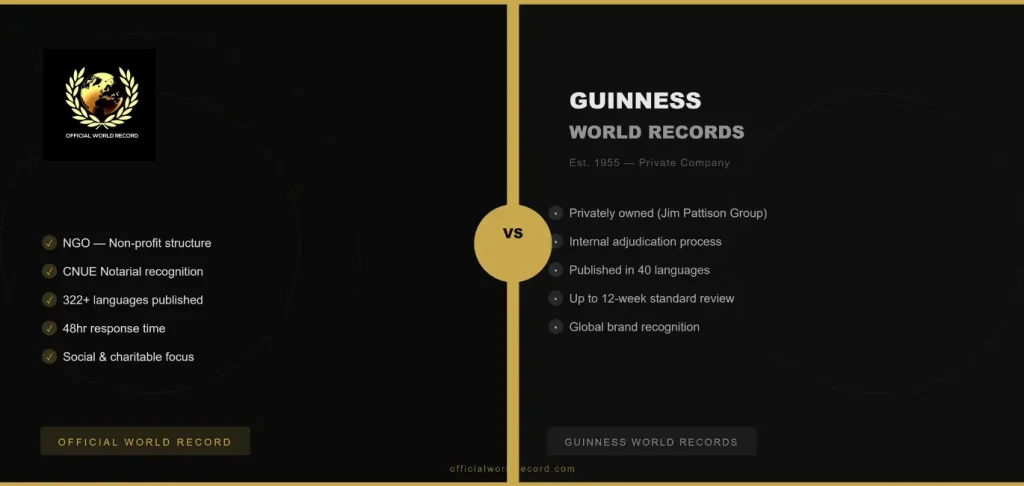
OWR, by contrast, is structured as a registered NGO, with legal status in both Spain and the United States. Its stated mission centers on promoting world records for charitable causes, social advancement, environmental awareness, and inclusion – particularly for people with disabilities or social challenges. This NGO structure shapes everything from how OWR evaluates applications to the kinds of records it actively seeks to promote.
Neither structure is inherently “better” – they simply reflect different priorities. A private company can invest heavily in global media presence and brand recognition; an NGO can prioritize mission-driven causes and offer more personalized engagement with applicants.
Legal Recognition and Notarial Validation
This is where OWR’s positioning is most distinct. OWR is recognized by the Council of the Notariats of the European Union (CNUE) — a recognition tied to the apostille, a certification under the Hague Convention of 1961 that validates documents for legal use across the convention’s member countries. According to OWR, it is the only world records register organization to hold this specific notarial recognition.
Guinness World Records does not operate through this notarial framework. Instead, it functions as the effective authority for many of its record categories, providing its own adjudicators to verify record attempts, with an internal Records Management Team reviewing evidence submitted online.
In short: Guinness relies on its own internal adjudication process and decades of brand authority, while OWR layers in third-party legal/notarial validation as part of its credibility framework. Which one matters more to you may depend on whether you value institutional brand recognition or independent legal validation.
Application Process Compared
Guinness World Records: Applications are evaluated individually, and the standard process can take up to 12 weeks from submission to receiving record guidelines. Guinness receives over 50,000 record applications a year, and around 60% of new record proposals are rejected. A Priority Application option is available for individuals applying for personal achievement records, reviewed within 5 working days for an additional fee. Organizations and brands are generally directed to Guinness’s fee-based Consultancy service.
Official World Record: OWR’s process is built around a more personalized model. According to OWR, applicants typically receive a response within 48 hours of their initial inquiry (excluding local holidays), after which Instruction Judges — assigned by record category — review and admit the application. From there, OWR’s International Acceptance Committee formally approves the record category and rules before the attempt proceeds. Once the attempt is complete, judges verify the submitted evidence before certification is issued.
The key difference: Guinness operates at a much larger scale with a longer standard turnaround, while OWR positions itself around faster initial response times and individualized handling of each application — though exact processing time will vary by record complexity in both cases.
Cost Comparison
Costs differ significantly between the two organizations, and both have more nuance than a single flat fee.
Guinness World Records: Applications made by individuals for existing record categories are free of charge, with a $5 administration fee to propose a new record title. However, a Priority Application service (guaranteeing a response within five working days) costs around $800 to $1,000, and niche or consultative records for brands or events — including an official adjudicator attending in person — can run into the thousands or more, depending on the scope of service required. Record holders are also responsible for all costs tied to the attempt itself, including equipment, venue, and witnesses.
Official World Record: OWR’s standard practice is to communicate applicable fees directly with applicants after the initial review of their proposed record, rather than publishing a single fixed price list. If you’re considering applying, we’d recommend reaching out directly through OWR’s application form to get fee details specific to your record category.
If pricing transparency is a top priority for you, it’s worth contacting both organizations directly to compare current rates for your specific record type before committing.
Global Language and Accessibility (320+ languages)
Guinness World Records is currently published in 100 countries and 40 languages.
OWR, by comparison, publishes its official record book in over 322 languages — a notably broader linguistic reach, including many regional and minority languages not typically covered by larger publishing operations. For applicants whose records are tied to specific regional or cultural communities, this can mean a more accessible and representative way to have an achievement documented and shared.
Which One Is Right for You?
There’s no single “better” choice — it depends on what you’re looking for:
Guinness World Records may be the better fit if you want:
- Maximum brand recognition and global pop-culture visibility
- A free application process for existing record categories
- A long-established, internationally known publishing platform
Official World Record may be the better fit if you want:
- A more personalized application experience with faster initial response times
- Legal/notarial validation through recognized European notarial institutions
- A record tied to a charitable, social, or inclusive cause as part of an NGO’s mission
- Broader language representation, including underrepresented regional languages
- To support an organization whose proceeds help fund non-commercial and humanitarian record documentation
Final Verdict
Guinness World Records and Official World Record both serve the same core purpose — verifying and celebrating extraordinary human achievement — but they do it through different institutional models. Guinness brings decades of brand recognition and a globally familiar publishing platform. OWR brings a younger, NGO-driven structure with notarial legal recognition, a strong focus on social and charitable impact, and one of the most linguistically diverse record books in the world.
The right choice comes down to what matters most to you: global brand familiarity, or a more personalized, mission-driven, and legally validated path to having your achievement recognized.
Learn more about OWR’s verification process and see if it’s the right fit for your record.