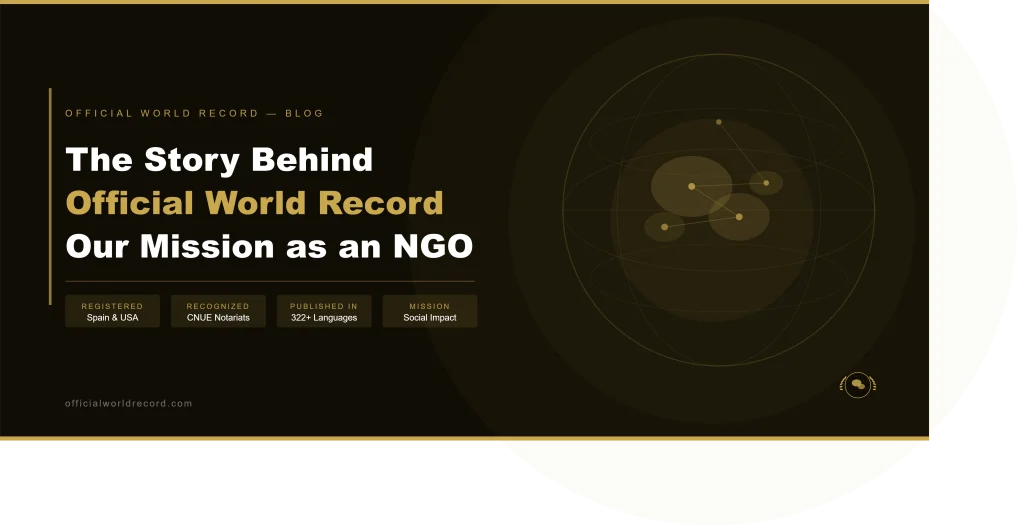
Most people who come across Official World Record (OWR) for the first time know us as the organization that verifies and certifies world records. But behind every certificate and trophy is something bigger: a non-governmental organization built on the belief that human ambition, when properly recognized, can become a force for real-world change.
This is the story of how OWR came to be, what drives it, and why it operates as an NGO rather than a private business.
How OWR Started and Why
Official World Record Association was founded in the 21st century in Barcelona, Catalonia (Spain) — born from a simple but ambitious idea: that the world needed a record-keeping institution built for today’s values, not the standards of the last century.
From the outset, OWR was created as a non-governmental organization, with a clear and specific purpose: to promote, verify, catalog, and register world records — not as commercial spectacle, but as a meaningful tool for recognition and impact. As the organization puts it, OWR represents “the record of world records with values of the 21st century” — a deliberate departure from older, more commercially driven record-keeping models.
What sets that founding moment apart is the intent behind it. OWR wasn’t built to compete on volume or flashy claims. It was built around rigor, personalized treatment for every applicant, and a genuine commitment to using world records as a vehicle for social good — principles that still define how the organization operates today.
Our Mission: Promoting Records for Social and Charitable Causes
At its core, OWR exists to do more than catalog impressive feats. The organization’s founding principles are explicit about this: world records are promoted “among non-profit organizations, NGOs, for charitable purposes, and for people with disabilities or with social problems fundamentally” — used as a basic tool to raise awareness for social causes and to help fundraising efforts for community-focused entities.
This mission plays out across several areas of focus:
- Sustainability and environmental records — recognizing achievements like reforestation efforts, renewable energy innovation, and carbon footprint reduction, using records as a platform to raise global awareness around climate action
- Social advancement and human rights records — certifying milestones around inclusion, education, and the empowerment of vulnerable groups
- Public health and global well-being records — supporting fundraising and awareness campaigns tied to medical research and access to treatment
- Economic development and local promotion records — using record-setting events to support tourism, local industry, and community growth
OWR also makes a point of recording achievements “that no one else would” — niche, non-commercial records that hold genuine cultural or humanitarian value, even when they aren’t likely to attract mainstream attention. This is part of what the organization describes as preserving “the romantic spirit of knowledge for the sake of knowledge,” rather than chasing commercial record-setting trends.
Legal Recognition Across the World
Operating as an NGO isn’t just a philosophical stance for OWR — it comes with formal legal standing that very few record-keeping organizations can claim.
OWR is legally registered as an NGO in both Spain and the United States, giving it an institutional structure that’s fundamentally different from privately owned record companies. It’s also a registered trademark with the European Union Intellectual Property Office (EUIPO), under registration number 013986054.
Perhaps most notably, OWR is recognized by the Council of the Notariats of the European Union (CNUE) — the only world records register organization to hold this distinction. This recognition is tied to the apostille, a certification established under the Hague Convention of 1961, which validates documents for legal use across the 114 member countries of the Convention. In practice, this means OWR’s certifications carry a level of international legal credibility that’s unmatched among record-keeping organizations.
This legal foundation is what allows OWR to operate with the same seriousness and structure as a formal institution — not just a record-tracking website, but a recognized organization with accountability built into its process.
Supporting People with Disabilities and Social Causes
One of the areas OWR is most genuinely proud of is its commitment to inclusive world records — records where no one is excluded from participating because of a physical, mental, or developmental disability.
This isn’t a side initiative; it’s described as one of the organization’s most rewarding areas of work. The belief behind it is straightforward: setting a record is fundamentally about breaking the limits placed on people, and everyone — regardless of ability — deserves the chance to push past their own limits and be recognized for it.
This principle has shaped some of OWR’s most meaningful certifications, including records tied to inclusive sports initiatives and partnerships with organizations focused on health and social transformation. It’s a direct expression of the organization’s broader belief that world records should serve people, not just spectacle.
Our Global Community of Volunteers
OWR’s reach extends well beyond its Catalonia headquarters. The organization maintains a presence and dedicated collaborators in strategic locations around the world, including Pakistan, Nepal, Korea, Vietnam, the United States, and Puerto Rico — allowing it to evaluate record attempts with both cultural sensitivity and the technical rigor each category demands.
This global network is built on collaboration. As OWR puts it, “growth is only possible through shared passion, diverse skills, and meaningful collaboration.” Whether someone wants to volunteer their time, contribute specialized expertise, or partner with OWR on a new initiative, every contribution helps expand the organization’s global impact — setting new records, inspiring communities, and creating opportunities for people around the world.
This same spirit of collaboration runs through OWR’s International Committee of Experts — a group of engineers, scientists, historians, and metrology specialists who help guard the integrity of the organization’s standards, ensuring every record is measurable, verifiable, and fair.
What’s Next for OWR
OWR’s mission is far from finished. The organization continues to expand its global footprint, grow its database — already one of the most comprehensive collections of human achievement in the world — and publish its official record book in over 322 languages, making recognition accessible to communities that have historically been left out of mainstream record-keeping.
As OWR continues to position itself alongside more established record organizations, its focus remains the same as it was at its founding: prioritize moral and cultural quality over commercial volume, maintain the personalized, human treatment that defines every application, and continue using world records as a genuine force for social good — not just a spectacle to be marketed.
Join Our Mission
OWR’s story isn’t just about an organization — it’s about the thousands of individuals, social organizations, and businesses who’ve used world records to make their achievements, causes, and contributions matter on a global scale.
Whether you want to set a record yourself, support a charitable cause through a record attempt, or contribute your time and expertise as a volunteer or collaborator, there’s a place for you in OWR’s mission.
Apply to Register a Record or Join Us as a Volunteer or Collaborator — and become part of an organization that believes every record should mean something.